What a Novus Convert Account Remembers, and What It Never Will
Accounts have arrived on a site whose whole promise is that your files never leave your device. Here is exactly what an account stores, what it refuses to store, and why you may not need one.
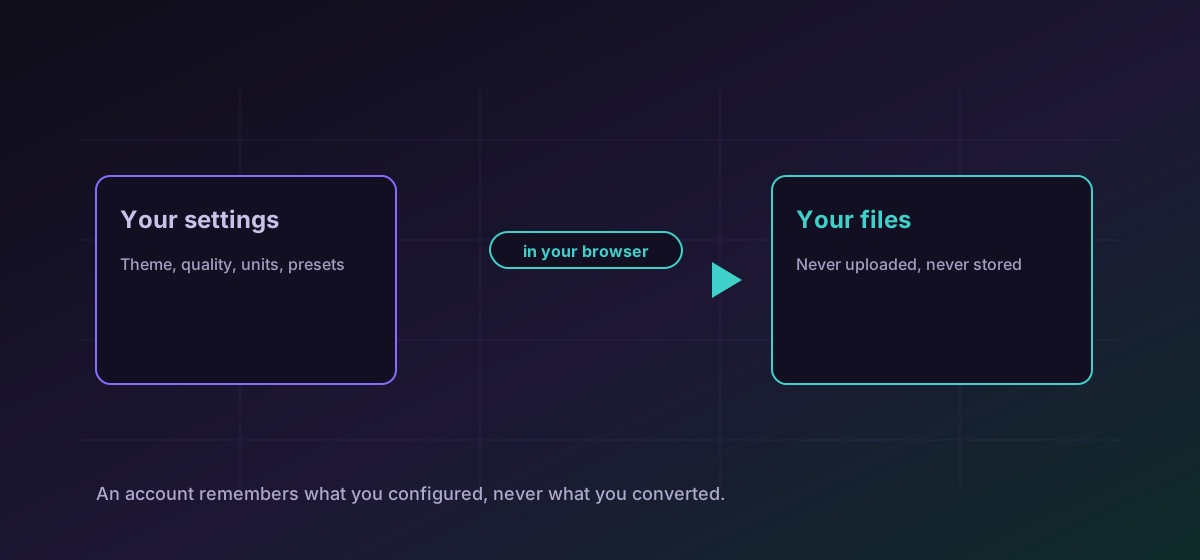
Adding accounts to a site that exists because it does not take your files deserves an explanation rather than a changelog line. So here is the whole of it: an account on Novus Convert remembers what you configured. It never remembers what you converted.
That distinction is not a marketing line. It is enforced in the database schema, and there is a test that fails the build if a column appears that could hold a file name.
What an account stores#
- Your email address and a username, because either one can sign you in. A username is required when you register with a password; accounts created through Google do not have one.
- A password, stored as a salted hash. Nobody, including us, can read it back.
- Your settings: theme, reduced motion, default quality, units, and whether STL output is binary.
- Presets and saved pipelines, which describe conversion steps between formats, not the files you ran through them.
What it refuses to store#
- No file contents. Conversion still happens entirely in your browser; there is no upload to store.
- No file names. Not truncated, not hashed, not in an error message.
- No file paths, and no exact byte counts. A size to the byte plus a timestamp identifies a specific file about as well as its name does.
Nothing about the tools changes#
Every conversion route works exactly the same signed in or signed out. There is no gated format, no faster queue, and no larger limit for members. The full format catalogue is the same catalogue either way.
Advertising is also unchanged. Signing in is not an ad-free tier and was never intended to become one by accident, which is why there is a test asserting that the account pages still carry the ordinary placements. The two credential pages are the exception, because putting an advert beside a password field is a bad idea on its own merits.
You probably do not need one#
This is worth saying plainly, and more plainly than a launch article usually would. Today an account carries your saved presets between devices, and that is the whole of it. The settings on the account page are stored, but nothing reads them back yet: the theme and motion controls still take their answer from the browser you are sitting at, and the default quality and units are recorded against your account without changing what the converter does. That wiring is owed work, not a feature, and describing it as one would be exactly the sort of thing the rest of this article promises not to do. If you convert a file occasionally from one browser, an account buys you nothing at all.
The reasoning behind the local-only architecture has not changed, and is set out in where your files go and on the security page.
Signing in#
You can sign in with an email address or with a username, in the same field. Registering with a password requires both: the username is a second way in, not an optional decoration. Accounts created through Google have no username and sign in with Google instead. Passwords are a minimum of twelve characters, which is longer than most sites ask and is the cheapest security decision available.
Troubleshooting
Keep using the password for now. Implicit linking is refused on purpose, because no address here is verified and allowing it would let someone pre-register another person's address. The supported route is to connect Google from an authenticated session, and there is no control for that on the account page yet, so the two sign-in methods cannot currently be joined.
Google accounts have no username. Sign in with Google, or set a password on the account first.
They do not yet. Saved settings are stored against your account but nothing reads them back, so each browser still uses its own local preferences. Presets are the part that does travel.
The minimum is twelve characters. It is a deliberate floor rather than a default.
Frequently asked questions
Do you store the files I convert?
No. Conversion happens entirely in your browser and nothing is uploaded, so there is no file to store. The account database has no column capable of holding file contents, and a test fails the build if one appears.
Do you store the names of my files?
No. Not in full, not truncated, and not in error records. There is no conversion history at present; when it arrives it will be optional, off by default, and will store only the formats involved, a rough size band, a duration and an outcome code.
Does an account remove ads or unlock formats?
Neither. Every conversion route and every limit is identical signed in or out, and the account pages carry the same advertising as the rest of the site. Signing in is not a paid tier in disguise.
Do I need an account to use the converter?
No, and most people should not bother. An account carries your saved presets between devices. Stored settings do not change the converter yet, so if you use one browser it already remembers your preferences locally and an account adds nothing.
How do I delete my account?
Through the contact page, for now. There is no delete control on the account page yet. When the record goes, the settings, presets and any history rows go with it, and there are no files to delete because there never were any.