EML, ICS and VCF: The Files Your Inbox Hands You
Saved emails, calendar invitations and contact cards are all plain text files with a standard behind them. What each one holds, how to read it outside the app that made it, and why they deserve care.
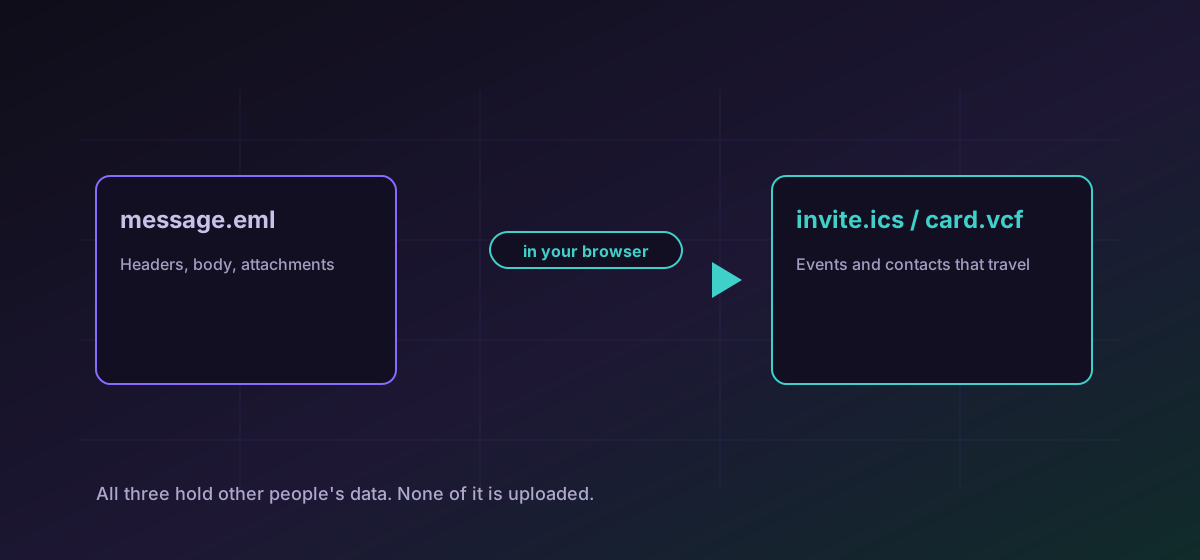
Three file types arrive from mail clients often enough to be worth understanding, and rarely enough that nobody quite does. An .eml is a saved email. An .ics is a calendar invitation. A .vcf is a contact card. All three are text with a published standard behind them, which is why they survive being moved between applications that agree on nothing else.
EML: one email, exactly as it arrived#
An EML is a single message in the format email actually travels in. Headers at the top, body underneath, attachments encoded inline. Drag a message out of most mail clients and this is what lands on your desktop.
It is the closest thing to evidence that email produces, because it carries the full header trail rather than the tidied summary a client shows. If you need a message to be readable by someone without your mail client, or filed somewhere permanent, converting it is reasonable. See the EML format reference for what this site supports.
MBOX: many messages in one file#
MBOX is the format mail archives export to, and it is essentially a great many EML messages concatenated together. It is what you get from a mailbox export, and it is usually enormous. See the MBOX format reference for its handling here.
ICS: a calendar entry that travels#
An ICS file describes an event: start, end, timezone, title, description, attendees and often a recurrence rule. It is the reason an invitation from one calendar system lands correctly in another.
The part that causes trouble is timezones. An event stores a time and the zone it belongs to, and applications differ in how carefully they apply that. A meeting that shifts by an hour after being moved between systems is almost always a timezone interpretation rather than a corrupted file.
VCF: a contact card#
VCF, or vCard, holds one or more contacts: names, numbers, addresses, organisations and sometimes a photograph. Phones, mail clients and address books all read it, which makes it the practical way to move contacts between ecosystems.
It is also, unambiguously, personal data about other people. A contacts export is one of the most sensitive files most people ever handle, and it is routinely treated as though it were not. Working with it locally rather than uploading it is the obvious precaution, and the reasoning is the same one set out in where your files go.
Practical notes#
- All three are text. Opening one in a text editor to see what it holds is a reasonable first move and costs nothing.
- A calendar time that looks wrong is usually a timezone rule, not damage. Check the zone before assuming a broken file.
- An exported contact list should be reviewed before it is shared. It usually contains more people than intended.
- Attachments inside an EML are encoded rather than separate, which is why the file is larger than the message looked.
If the goal is a readable, archivable copy rather than a working file, the documents to PDF guide covers that destination.
Troubleshooting
Almost always a timezone interpretation rather than a damaged file. Check the zone recorded in the event and what the receiving application assumed.
A VCF may contain several cards, and address books match on different fields. Review the file as text first to see how many contacts it holds.
Attachments are encoded inside the file rather than stored separately, which adds roughly a third to their size.
It is many messages in one file. Split it or work with a subset rather than loading the whole archive at once.
Frequently asked questions
What is an .eml file?
A single email saved in the format email actually travels in: headers, body and encoded attachments. It is what most mail clients produce when you drag a message out of the window.
Why does my calendar invitation show the wrong time?
Nearly always a timezone rule rather than a broken file. An ICS event records a time and the zone it belongs to, and applications vary in how they apply that.
Is it safe to convert a contacts file?
Here, yes, because it runs in your browser and nothing is uploaded. It is worth pausing regardless: a contacts export is personal data about people who never agreed to it being moved anywhere.
What is the difference between EML and MBOX?
An EML holds one message. An MBOX holds many, concatenated into a single file, which is why mailbox exports are usually MBOX and usually very large.
Can I remove personal details by converting?
No. Converting changes the container, not the contents. Headers, attendee lists and contact details survive the trip, so review the file rather than assuming a conversion sanitised it.