Converting a Font Does Not Grant the Right to Embed It
The most common font mistake is treating a successful conversion as permission. A plain guide to what desktop, web and app licences usually separate, and what to check first.
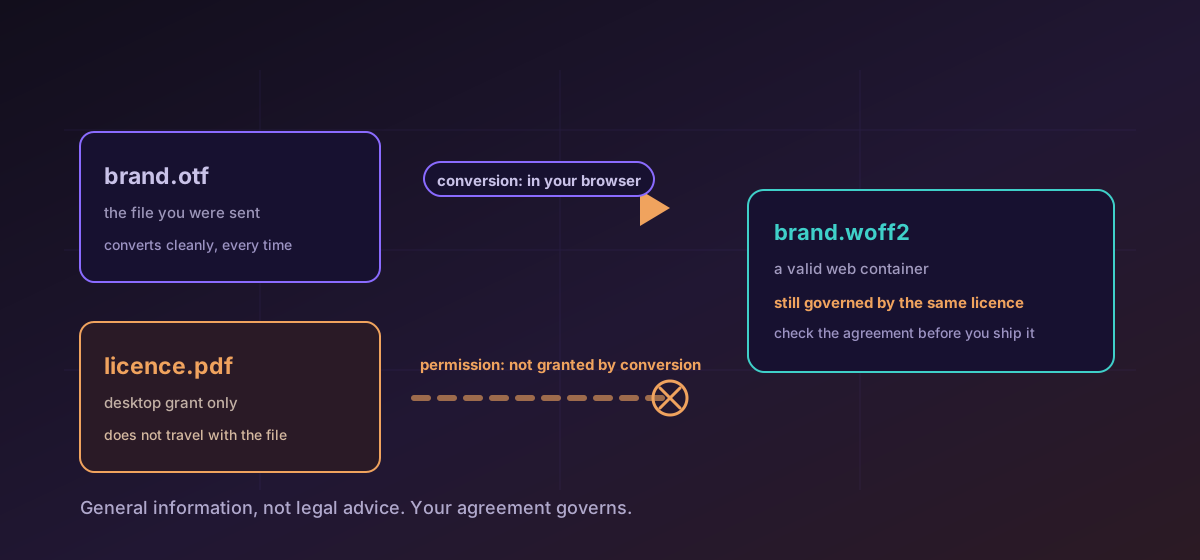
This article is general information about how font licences are usually structured. It is not legal advice, it does not describe your particular agreement, and nothing here overrides the document a foundry actually sent you. Read that document, and ask the foundry when it is unclear. With that said, there is one mistake that turns up more often than every other font problem combined, and it is worth naming plainly.
The permissions that are usually sold separately#
Commercial foundries typically break usage into distinct grants, and buying one does not include the others. The exact names vary, but the shape is consistent enough to be worth knowing before you open TTF to WOFF2 and assume the job is done.
- Desktop covers installing the font on a set number of computers and producing static artwork with it. This is the grant most people already hold, and it is the one that most often says nothing about the web.
- Webfont covers serving the font to browsers. It is frequently metered, by monthly page views or by domain, and it frequently requires the file to be a web container rather than a raw TTF linked directly.
- App and game covers embedding the font inside a piece of software you distribute, which is a different exposure again because the file ships to the user's device.
- Ebook and document embedding covers the font travelling inside a file you publish, which is why a PDF that embeds a typeface can need a grant the same artwork printed on paper does not.
- Broadcast, logo and merchandise terms exist at some foundries and can restrict the very uses a brand cares about most.
Clauses that catch people out#
Beyond the grant itself, a handful of specific clauses cause most of the trouble. Modification is the first: some licences forbid altering the font file at all, and a repackaging step is a modification under a strict reading even when the outlines are untouched. Subsetting is the second, and it is a genuine modification by any reading, so a licence that permits web use may still forbid cutting the character set down. Self-hosting is the third: some webfont licences require you to serve from the foundry's own delivery service, which means the converted file you made locally is not the file you are permitted to ship.
Page-view caps deserve their own mention because they are easy to agree to and easy to outgrow. A site that quietly succeeds can pass a tier boundary without anyone noticing, and the licence does not enforce itself. If your agreement is metered, put the threshold somewhere your analytics review will actually surface it.
Open licences are permissive, not unlimited#
A font released under the SIL Open Font License can generally be used on the web, embedded, modified and converted, which makes it the straightforward choice when a project has no budget for type. It still has conditions. The font itself may not be sold on its own, any derivative must be released under the same licence, and if the original declares a Reserved Font Name then your modified version has to be renamed. Open does not mean unconditioned. It means the conditions are published and you can read them before you open OTF to TTF rather than after.
A practical order of work#
- Find the licence before you find the font file. If you cannot locate the agreement, you do not yet know what you are allowed to do, and a file sitting on a shared drive is not evidence of anything.
- Match the grant to the use you actually have in mind, including every surface: the marketing site, the logged-in app, the PDF invoices, the mobile build.
- Check specifically for modification, subsetting and self-hosting language before converting or slimming anything.
- Keep the licence, the invoice and the original file together with the project, so the next person can answer the question without guessing.
- Convert last, and treat the converted file as governed by the same agreement as the original.
When the licence does clear the way, the mechanics are straightforward and covered in converting TTF, OTF, WOFF, WOFF2 and EOT. If you have inherited a web font and need a desktop copy simply to identify what it is, WOFF to TTF will unwrap it, though identifying a font is not the same as acquiring the right to use it.
Troubleshooting
Treat the font as unlicensed for the new use until you can produce the agreement. A file on a shared drive is not evidence of a grant.
Check for a clause requiring delivery from the foundry's own service. Some webfont grants do not permit a locally hosted copy.
Subsetting is a modification. Confirm the licence permits it before cutting the character set, even when web use is clearly allowed.
Page-view tiers do not enforce themselves. Put the threshold into a review that someone actually reads each month.
Frequently asked questions
Does converting a font change what I am allowed to do with it?
No. Conversion changes the container, not the agreement. A desktop licence that is silent on web embedding stays silent after you produce a WOFF2 from it.
Is this legal advice?
No. This is general information about how font licences are commonly structured. Your agreement governs, and a foundry or a qualified adviser is the right place to take a specific question.
Can I use any font I already own on my website?
Not automatically. Web embedding is usually a separate grant from desktop installation, and it is often metered by page views or restricted by domain. Check the agreement for the specific surface you have in mind.
Are open-source fonts completely unrestricted?
They are permissive, not unconditioned. The SIL Open Font License generally allows web use, modification and conversion, while still forbidding selling the font on its own, requiring derivatives to carry the same licence, and requiring a rename where a Reserved Font Name is declared.
Does the converter keep a copy of my font?
No. The file is read and rewritten in your browser and nothing is transmitted. That matters for a commercial typeface and matters more for an unreleased one.