AC-3 and DTS: Surround Channels and the Downmix You Cannot Undo
Where the surround formats from DVD and Blu-ray came from, what the six channels of a 5.1 mix actually carry, and why a stereo device gets a fold-down that no later step can reverse.
A bare .ac3 or .dts file almost always means the same thing: somebody pulled the audio out of a disc or a video file. Neither is something you record into: both are delivery formats for cinema and home theatre. The questions that follow are always about channels, and about what happens on a device with two speakers.
What 5.1 actually means#
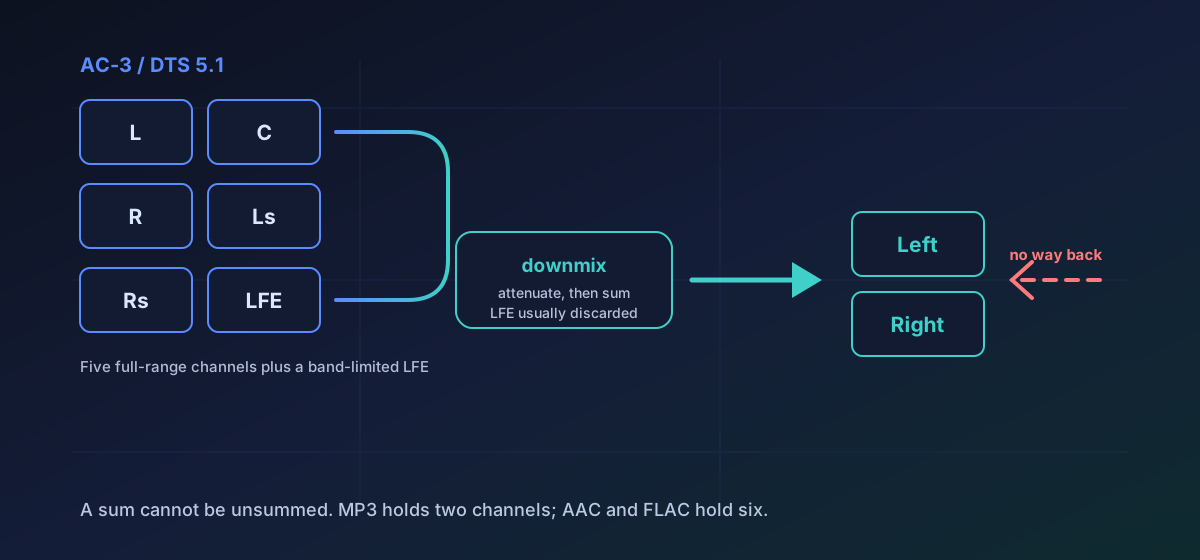
A 5.1 mix is six discrete channels, not a stereo signal with an effect on it. Five are full-range and meant for five separate speakers. The sixth is not a speaker channel in the same sense, which is why it is written as a fraction.
- Left, centre and right sit across the front. The centre channel carries most of the dialogue in a film mix, which is the most important fact in this article.
- Surround left and surround right sit behind or beside the listener and carry ambience, reflections and movement.
- LFE is the low-frequency effects channel, band-limited to roughly the bottom 120 Hz. It exists to give a subwoofer something to do and holds a small slice of the spectrum, hence the '.1'.
AC-3 was the default, DTS was the alternative#
Dolby developed AC-3 for cinema from 1991, and Batman Returns carried the first theatrical Dolby Digital soundtrack in 1992. Becoming the mandatory codec for DVD-Video and ATSC television made it the dominant consumer surround format for twenty years. It is a perceptual MDCT transform codec carrying up to 5.1 channels, reaching 640 kbps, with 448 kbps the customary DVD ceiling. E-AC-3, sold as Dolby Digital Plus, extended the family into streaming.
DTS arrived in cinemas in 1993 with Jurassic Park, playing from CD-ROMs synchronised to the film print rather than from the print. The consumer Coherent Acoustics codec became an optional DVD format in 1997 and used subband coding at much higher rates: 768 and 1509 kbps are the common ones, against AC-3's 448. Extensions followed, including DTS-ES 6.1 and the lossless DTS-HD Master Audio tiers on Blu-ray, each embedding a backward-compatible lossy core so an older decoder still gets sound.
Both share a practical problem: browsers do not license the decoders, and neither do many phones and smart-TV apps. A video that plays with a picture and no sound is very often one of these tracks. Convert AC-3 to AAC for something the web will actually play, or see the AC-3 format page and the DTS format page for the full variant list.
The downmix is the part that cannot be reversed#
When a 5.1 track meets a two-channel destination, a decoder folds it down: the centre is attenuated and added to both sides, the surrounds are attenuated and added in, and the LFE is usually discarded outright because most stereo playback cannot use it and folding it in invites clipping. AC-3 streams carry downmix coefficients so the decoder folds the way the mixing engineer wanted.
Which targets can hold the channels is a property of the codec. AAC and FLAC both carry more than two, so a 5.1 source has somewhere to go: convert DTS to FLAC if you want the channel layout intact and lossless from that point on. MP3 cannot. The LAME encoder writes mono or stereo only, so choosing AC-3 to MP3 means a fold-down happens whether you asked for one or not. That is a reasonable choice for a phone and a bad one for an archive. Check the channel count on the output, because a downmix is silent about having occurred.
The metadata that does not travel#
AC-3 carries dialnorm and dynamic-range control values inside the bitstream so broadcasters can hold loudness steady across programmes. Neither is descriptive metadata in the ID3 sense, and neither has a home in a bare AAC or FLAC stream. If a converted track plays noticeably louder or quieter than it did through a receiver, that metadata is usually why, and the fix is a level adjustment rather than a different conversion.
Lossless containers do not launder a lossy core#
The AC-3 bitstream and the DTS core are both lossy. Writing them into FLAC preserves exactly what is there and nothing more, in the same way converting an MP3 to FLAC preserves the MP3's artefacts at four times the size. It is still the right move when the audio is going into an edit, because it stops further generational loss. A file named .flac is a claim rather than a measurement.
If the surround track is still inside a video file, extracting audio from video is the step that comes first.
Troubleshooting
A DTS or AC-3 audio track is the prime suspect, because browsers do not license those decoders. Convert the audio to AAC and remux, rather than re-encoding the picture.
The target codec could not hold more. MP3 is mono or stereo only, so anything wider is folded down before encoding. Choose AAC or FLAC when the channel layout has to survive.
That is the downmix. The centre channel carried the dialogue and has been attenuated and summed into both sides. It cannot be separated out again, so go back to the multichannel source and fold it down with different coefficients.
AC-3 carries dialnorm and dynamic-range values inside the bitstream and plain AAC or FLAC has nowhere to record them. Adjust the level on the output; no alternative conversion route restores the metadata.
Frequently asked questions
Why does my browser play the video but not the sound?
Browsers almost never ship AC-3 or DTS decoders, because the licensing costs money. The picture decodes and the audio track is simply ignored. Converting the audio to AAC is the standard remedy.
Can I get 5.1 back from a stereo file?
No. A downmix adds the channels together, and addition is not reversible. Upmixing produces six channels of plausible-sounding output, but the centre channel is not recovered and the dialogue stays mixed into the music.
Which output formats keep all six channels?
AAC and FLAC can both carry more than two channels. MP3 cannot: the LAME encoder writes mono or stereo only, so a 5.1 source is folded down on the way in every time.
Is DTS better than Dolby Digital?
DTS core streams generally run at higher bitrates, 768 or 1509 kbps against AC-3's typical 448, which is why enthusiasts favoured them. Both are lossy and the difference on ordinary equipment is far smaller than the bitrate gap suggests.
Does converting to FLAC improve a DTS track?
No. The DTS core is lossy, and FLAC preserves exactly what it is given. It is worth doing before an edit, because it prevents further generational loss, but it recovers nothing that DTS discarded.